· 3 min read
Demystifying the art of Active Directory Multitenancy
A quick Google search of "Active Directory Multitenancy" might leave you more confused than informed. This blog aims to provide clarity on where and how multitenancy in Active Directory makes sense—and address a few comm.
Demystifying the Art of Active Directory Multitenancy
A quick Google search of “Active Directory Multitenancy” might leave you more confused than informed. This blog aims to provide clarity on where and how multitenancy in Active Directory makes sense—and address a few common misconceptions.
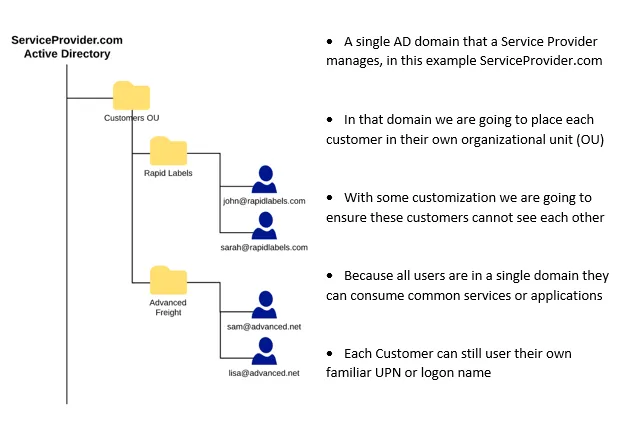
Let’s start with a definition: much like other forms of multitenancy, Active Directory Multitenancy means multiple customers share a single Active Directory (AD). Picture it like this:
Why Use Active Directory Multitenancy?
The goal is to simplify and standardize what could otherwise be a complex setup. By investing upfront in building shared infrastructure and automating customer onboarding, you can deliver services at scale—cost-effectively.
This approach makes economic sense. As each new customer is added, the infrastructure costs remain largely fixed, improving margins and enabling a repeatable service model.
A Historical Example: Hosted Exchange
Before Office 365, businesses wanting enterprise email features—like out-of-office replies—had to build their own Exchange server. It was costly and complex.
Hosted Exchange providers made this more accessible. By allowing customers to share a single Exchange deployment (on a shared AD), they could deliver enterprise-grade services for just a few dollars per user per month. For small businesses, the value proposition was obvious.
While Hosted Exchange may not be the ideal starting point for today’s service providers, many ERP, accounting, and line-of-business applications still follow this same legacy architecture—and many are still dependent on Active Directory.
The Opportunity
If you’re an application developer or run a consulting business supporting apps that require AD, there’s a clear opportunity. By hosting these applications on shared infrastructure, and using a multitenant AD model, you can:
- Maintain a single, standardized environment
- Support even single-user customers profitably
- Scale consistently and securely
Common Misconceptions
Here are four misconceptions that often show up when researching Active Directory Multitenancy:
Misconception 1:
“Stop looking at Active Directory Multitenancy—what you need is a cloud identity tool!”
Cloud identity tools are great for modern SaaS authentication, but they don’t replace AD when your application or service still depends on it. You’ll still need AD, either single-tenant or multitenant, behind the scenes.
Misconception 2:
“Just spin up a VM for each customer’s AD. It’s easy!”
Yes, spinning up VMs is faster than ever. With clever scripting, you can automate deployment. But the issue isn’t technical—it’s economic.
Dedicated AD infrastructure per customer quickly escalates cost and complexity. It also prevents you from sharing application, desktop, and database servers—driving the price per user too high and creating barriers like minimum user counts.
Misconception 3:
“Sharing an AD is a terrible idea—you’re locking in your customers.”
That’s not quite accurate. Many customers still have their own on-premises AD. The multitenant AD is simply an authentication layer for your service—just like Office 365 relies on Azure AD in addition to on-premise AD.
For services like hosted desktops, some customers are happy to trade direct AD ownership for a more flexible service model.
Misconception 4:
“It’s too complex—AD wasn’t designed for multitenancy.”
It’s true—multitenant AD is complex. Without the right tools and automation, it’s error-prone and difficult to scale.
That’s exactly where Atria comes in. Atria simplifies Active Directory management with an easy-to-use web portal that enables multitenancy while reducing risk and overhead.
Final Thoughts
Multitenant Active Directory is entirely achievable—with the right strategy and support. It’s a foundational step to transforming legacy applications into cloud-delivered services and can enable faster, more scalable growth.
If you’d like to learn more or discuss your specific scenario, we’d love to chat.
Learn more about Atria
Atria helps you deliver multitenant Active Directory securely, with automation and a self-service portal that makes onboarding and management easier than ever.